
Wild Geese
I'm getting conned by a pretty good band.

For once in my life I’m more or less on time to the zeitgeist, or at least the zeitgeist that exists in my specific corner of the internet, which I have reason to believe at least occasionally leaks into more mainstream cultural spheres. For once in my life I’m striking while the iron is lukewarm. Next time you hear from me, I’m sure I’ll be back to writing about some other bullshit only I care about.
The writer and musician Eliza McLamb recently published a great essay looking into the practices of a digital marketing agency called Chaotic Good. She specifically focuses on the agency’s connection to the band Geese and its frontman Cameron Winter, who’s lately been hailed as the savior of indie rock by a perhaps suspiciously high number of both critics and TikTok commenters. I think that McLamb’s essay about what this all means for the music industry and current working musicians basically says everything that needs to be said. But someone sent me another Substack article on the same subject by a Tony Price, which I frankly found insufferable, and it got me thinking about something that I’ve often wondered aloud to friends about but never really tried to articulate in writing.
Is it possible to make music (or any type of art), especially in the current moment, without referencing and/or imitating your antecedents? It possible to write about music (or any type of art) without comparing it to its antecedents? If indeed impossible, is either inherently bad?
Personally, I go back and forth on this, because I love a reference and I love history and I don't think "originality" is a moral imperative for art. In my art history classes at Parsons nearly a decade ago, I saw firsthand how young aspiring artists deliberately resisted learning about the history of their preferred medium because they were too focused on their own output and attendant branding. But I also don't think that everything needs to be a reference in the first place, or explicitly acknowledged as one. And then at the same time, I generally only like old(er) media, and find myself underwhelmed if not outright irritated by so much of what comprises contemporary media. And then I’m also frustrated by the current culture of endless remakes and rehashings, the pervasive retromania that has gone far beyond beating a dead horse and is now kind of just parading the horse’s corpse around.
Last week, my coworkers were discussing Hilton Als' review of the 2026 Whitney Biennial for the New Yorker.1 He specifically calls out Precious Okoyomon's contribution to the show, a sculpture series of baby dolls (some in blackface) and stuffed animals stitched together, many of which are hanging from nooses. Als seems to think that Okoyomon is obliged to somehow reference Mike Kelley, who also very famously used stuffed animals in his work, and that their failure to do so is representative of the whole Biennial’s failure to acknowledge art history more broadly. I admit that I do always think of Kelley when I see stuffed animals in a fine arts setting, but I also don't think Okoyomon's work has to be in direct dialogue with his. In a way it already is anyway, given the context of its exhibition, because many, many visitors to the museum will make that connection on their own whether or not it’s stated aloud.
Or they won't, and maybe that's OK?
This issue of antecedent acknowledgment becomes a double-edged sword for creators, listeners/viewers, and critics alike, because the response to this acknowledgment ultimately hinges on whether you personally agree with the comparison. Their tasteless pastiches vs. our informed homages…
Tony Price writes:
Geese™ is not a rock and roll band.
They don’t sound like Television…They don’t sound like the Rolling Stones. They don’t sound like the Velvet Underground…They don’t sound like Deerhunter…They don’t sound like the Strokes. They definitely don’t sound like the Fall…If anything, they sound like every single one of these bands discographies being streamed in HD at the same time through AirPods™. And that, my friend, sounds like a FUCKING RACKET.
I agree these comparisons, which are frequent in the reviews lauding their 2025 album Getting Killed, range from silly to asinine, because Geese’s music doesn’t really sound like them, but also because I think this is lazy writing. As much as I appreciate historical context, I am also sick of cultural criticism—or more broadly, reviews of Anything—that only compare the subject to other people in the field.2
If you look past his truly galling writing style, you can see that this guy Tony has a somewhat salient point about how these references ring hollow, in the case of Geese and so many others today, because almost nobody who’s created a viable career for themselves off their own creative work in 2026 can authentically share their references’ lifestyles. In other words, they’re not slumming it the way real punks did. But who in the music industry is, nowadays, except for the same musicians who are embarking on grueling tours without major label support and eating ramen while very much not being lauded by the masses?3
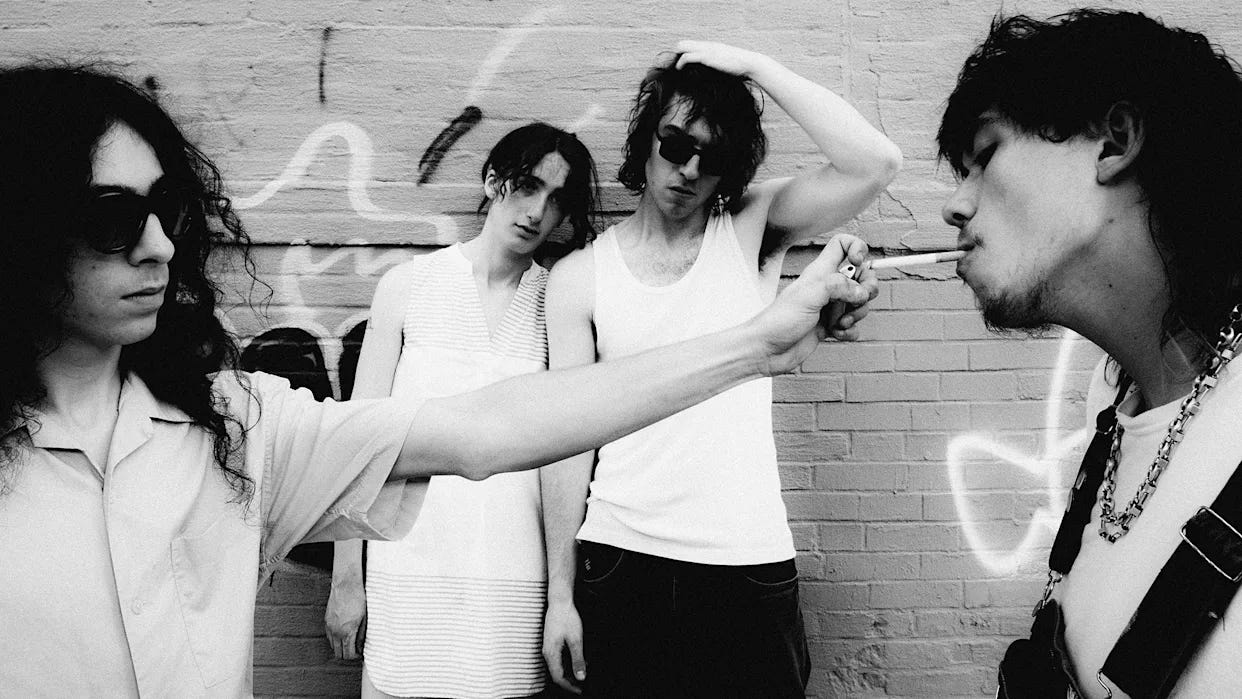
And in either case, does that affect the quality of the music itself? I ultimately like Geese’s music, even if I do find Cameron Winter himself a little cringe-inducing. But Emily Green is an excellent guitarist, and I’ve been known to listen to both Getting Killed and their 2021 album, Projector, with some frequency. I like their arrangements, how the violin interacts with the guitar, the emphatic use of trombone, and the manic structures their songs are often built around. I like the sputtering bass lines. I like their melodies, especially when they’re straightforwardedly pretty and in direct contrast to Winter’s less than conventional vocal style. Sometimes Winter’s lyrics are brutally corny, and sometimes they hit me right where I’m tenderest.
I think the other reason why people are having such a strong reaction to the uncovering of Chaotic Good’s marketing practices is that nobody likes to admit that they got got. We know how commercials work: even if the exact product isn’t immediately clear, we know that by the end of the ad there’s going to be a call to action that involves spending money on something. The “algorithm” is much more opaque.
It's scary to realize the extent to which our entire digital landscape is orchestrated by highly sophisticated corporate machinery. As much as we may try to cling to the old view of the internet as a democratic platform for community-building and organic “discovery,” it’s much more likely that any given piece of content you’re seeing on your feed is the result of decisions made by stakeholders who actually don't care—if at all—about the culture they're controlling. And it’s lowkey embarrassing to admit that you found yourself agreeing with the positive comments underneath a Tiny Desk concert video (or in this case, a From the Basement session), only to learn later on that those were probably all just bots echoing each other as part of a carefully curated “digital narrative”.
I do think that's worth being critical of, and I wish people were more vigilant about their own susceptibility to marketing in all its forms but especially online, whether from a major music label or a government agency dedicated to “apolitical” space exploration.4
The thing that saved me from total despair at the close of McLamb’s essay was her affirmation that she does actually like Cameron Winter’s song “Love Takes Miles,” and that her enjoyment of the song, the emotions and memories she associates with it, are real, and hers to keep long after Geese have disappeared from social media feeds. I found it lovely and moving the way she describes her discovery of the song, because it chimes so well with many of my own experiences: “How I came to know the song is almost irrelevant information at this point, eclipsed completely by the experience of loving the song on my own terms, creating my own memories with it.”
Even more succinctly, a comment on McLamb’s essay reads:

That’s the thing I didn’t get from Price’s essay, which was sent to me in part because it opens with a discussion of the Velvet Underground and the disputed authenticity of the obscurity that’s been ascribed to them in retrospect. Even when praising them, there’s no real acknowledgment of his own emotional connection to their music:
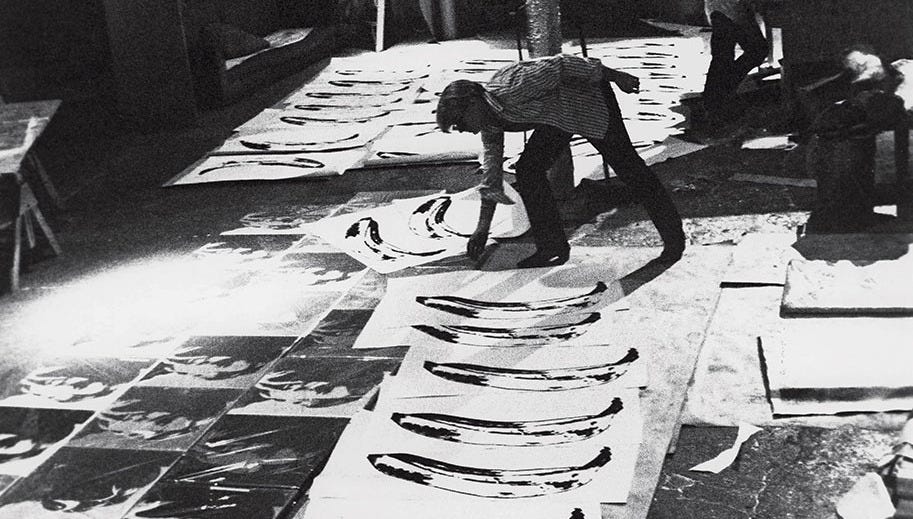
The Velvet Underground were, and still are, the greatest rock and roll band to ever exist. That’s not because some prick in a denim jacket at Rolling Stone™ made a living off of signalling that he was tuned into the counterculture, not because of what Brian Eno said, not because of that fucking Banana™.
So why are they so great, according to this guy? We’ll never know, because he immediately launches into like 3000 words of very unclever, millennial Lester Bangs cosplay. Oh, well.
I also didn’t get from Hilton Als’ essay what exactly it is about Mike Kelley’s work that he finds so moving compared to Precious Okoyomon’s. Even if you accept the premise that Kelley must be understood as ground zero for artistic plushie usage, why are his works successful in “engag[ing] with the passage of time, the commodification of emotion” while Okoyomon fails at their own stated goal of “thinking through a noncoercive rearrangement of desire”? Again, I guess we’ll never know, because Als’ review ends shortly after this conclusion with no further analysis.
What makes Television so good, or Deerhunter, or the Fall? Is making a reference to a canonical example of a medium worthwhile if you don’t identify what made it effective in the first place? Is that not equally as hollow as some chump citing the greats for inspiration even when their own work sounds like crap? Is liking something because a bunch of critics in the 1980s (or bloggers in the 2000s) decided it was cool any more or less authentic than liking something because you got it served to you by a social media algorithm? None of that matters anyway if we can’t articulate our own relationships to the work, what particular ways in which we’re moved and inspired and infuriated and frustrated by them, and why we return to them after that initial click.5
For the past 15 years, my primary source of music discovery has been cool girls I follow on Tumblr, which remains one of the last bastions of algorithmless internet. That and recommendations from friends (frequently the same people), non-friend radio shows (via KEXP, NTS, and WFMU), references made elsewhere, film soundtracks, and now the 1001 albums project which is frankly almost entirely mid but very occasionally leads me to an excellent record that I know for sure I would never have found otherwise.
At the very bottom of the list is current ambient conversation, the stuff that Chaotic Good is apparently working so hard to create. But that’s because I LIKE going out of my way to find new music. I’m aware that the vast majority of the world does not engage with music like this. Although it makes me sad and I can’t imagine living like that, I recognize that it is no great crime in theory. But I also think that kind of complacency in terms of what media you consume and how you consume it is worth resisting.
And yeah, maybe I fell for it anyway. But at the end of the day Getting Killed is a pretty good album, and at least I know why I think so.
The thing that bugged me the most about my classmates’ disinterest in the syllabi of our art history courses was the disinterest itself. There is no greater sin than incuriosity, especially for those who aim to develop their own creative practices, or at the very least comment on others’.
Bad taste can, however begrudgingly, be forgiven. But an unwillingness to interrogate what informs your taste is irredeemable.
— ECT
For the record, I like a lot of Als’ other writing, especially about cinema and literature, but I frequently find him ill-equipped to critique art in the same way. I’m not trying to compare him to this Substack guy at all.
Perhaps unsurprisingly, The Atlantic article about Geese is particularly bad. Immediately after comparing the band to Radiohead, author Spencer Kornhaber contradicts himself and says actually Geese are different, because they’re “more interested in rawk: momentum, drama, well-juxtaposed noise,” as if Radiohead hasn’t consistently done exactly that for the majority of their career. He then adds, absurdly, “Geese uses time signatures that you need a degree from Berklee to understand.” Hello????
Interestingly, this same conundrum, in the context of fine art, is the current focus of that world’s discourse.
Cough.
This whole time I’ve avoided going off on a tangent about the Strokes, because I think it’s hilarious that Price and other Geese haters have compared the two bands, with the Strokes as the Good Antecedent and Geese as the Shitty Derivation, when the Strokes themselves are just as shitty and derivative...if not more so. I do in fact have at least three dozen specific reasons for why I think the Strokes suck ass, but I’m not going to get into them here.
Really enjoyed reading this! And glad to know I wasn’t the only person who found that Tony Price piece to be insufferable lmao.
One thing I want to comment on with regards to your conclusion on incuriosity: I saw geese live back in October (fun but rowdy show!) and chatted with a bunch of people in line, most of them younger than me. Many of them were not only passionate about the band itself, but also the other music geese allowed them to discover and engage with. It was lovely to hear!
Obviously anyone is entitled to their own opinions on geese, but I do ultimately think that inviting younger people and opportunity to be passionate about art and engage with it further is a net good.